Fantasy Girlfriend Diary | If Aoi Kururugi Were My Hairstylist Girlfriend
This article contains affiliate links. This site participates in the DMM affiliate program, and we may receive a commission if you make a purchase through our links.

枢木あおい
美容師
From late Saturday night through Monday morning — a weekend shared in an apartment, complete with a Sunday kitchen haircut
The key turning in the lock woke me.
I’d fallen asleep on the sofa. The TV was still on, the clock past midnight. The front door opened, then closed. The sound of the key and chain followed. She didn’t flip on the hallway light. She never did when she thought I was asleep—she moved through the darkness like she belonged there.
”…Did I wake you?”
She said it softly from the living room entrance. The sound of her tote bag sliding off her shoulder. Saturdays were the salon’s busiest day. After closing, she swept the floor, washed the towels, locked up the register, and caught the second-to-last train home. That was the rhythm every week.
I told her I was awake. She laughed—a small laugh that said she didn’t believe me. She came out of the darkened hallway and leaned over the back of the sofa, upside-down face above mine. The smell of disinfectant alcohol reached me first. Then, underneath it, the faint chemical bite of hair dye. The smell of a full day of work.
“Did you eat?”
“Not yet. I’m done. Let me just sit for a minute.”
She moved around the sofa and sank down onto the floor. The sofa was right there, but she sat on the floor. Then she peeled off her socks and began slowly rotating her ankles. Right, then left. Each rotation made a small cracking sound. From nine in the morning until eleven at night—she barely sat down on that job. On days when her appointments were back-to-back, she’d told me lunch didn’t come until five in the evening.
Looking at the entrance, her platform sneakers lay scattered in opposite directions. She was usually meticulous, neat about everything, but there were nights she couldn’t be bothered. Saturday nights, mostly. In the hallway, things she’d dropped as she walked were arranged in a trail: the tote bag, a rolled-up apron, a hair tie. She was shedding the day’s equipment with each step closer to the apartment.
She didn’t ask me to massage her feet. But she was sitting there on the floor, soles toward me, waiting. So I pressed the ball of her foot with my thumb. She made small sounds—not quite “ow,” not quite “mm”—and closed her eyes. One menthol-scented patch was taped to her calf, mixing its mint with the chemical smell.
“How many cuts did you do today?”
“Lost count. Eight. Plus three colors.”
She kept her eyes closed while answering, turning her ankles. The TV light painted her tired face in pale blue.
I reheated the miso soup and arranged yesterday’s leftovers on the table.
A midnight dinner at half past twelve. She sat in front of the low table, pressed her palms together, and started eating. As she ate, she told me about the day. A regular client came in after three months and showed her a photo: “Cut it like this again.” She explained that even if you cut it exactly the same way, three months of growth changes how the bone structure reads. The cut would be different, even if you tried to make it the same.
“She tells me to cut it the same, but if I actually cut it the same, it won’t come out the same. Weird, right?”
She said it matter-of-factly, holding her bowl.
When I came back from my shower, she had spread a small leather case on the low table—two scissors she’d brought home from the salon. She only maintained them on weekends. She wiped each blade with a chamois cloth from root to tip in one direction, held them up to the fluorescent light, then opened and closed them to hear the sound. Snick, snick. The tightness of the screws tells her everything through the sound. If they’re slightly loose, the closing sound gets dull, she said.
I could see the stain by her fingernails—a pale grayish-blue. Ash-toned hair dye leaves a mark even through gloves, settles at the nail edge, never quite washes out. Her right index finger always had that faint gray. The base of her right thumb had a small hard callus where the scissors handle pressed against it day after day. I’d noticed it the first time we held hands before we started dating, but I never asked what caused it.
When she finished maintenance, she squeezed hand cream from a tube and slowly worked it into each finger. The last ritual of a day spent washing her hands dozens of times, spraying alcohol dozens of times. When she finished, she pressed her palm against my cheek and laughed: it’s gotten soft, right? The cream’s oil and her warmth lingered on my face.
“You’re off tomorrow, right?”
She said it while closing the tube.
“You are too.”
“Yeah. Your hair’s about at its limit. It’s getting heavy, overlapping. I’m gonna cut it tomorrow.”
She didn’t wait for an answer. She set the scissors case back in its place on the shelf.
On Sunday, she didn’t wake until noon.
When I checked at ten, she was wrapped in her futon like a cocoon, just her hair sticking out the top. I called to her, and from inside the cocoon came a muffled reply: thirty more minutes. I came back thirty minutes later, and it had shortened to fifteen. No room for negotiation.
Before noon, she finally appeared in the living room. Still bedhead, she sank into the sofa and hit play on a recorded pachinko program. Every time the host hit the reels, she’d bark at the screen—yeah, nope, something else. She knew every performer’s name. She could tell you whose technique was the cleanest, who was deliberately missing to hype up the show. Unsolicited commentary.
“Look at this guy’s hands. They’re seriously beautiful.”
She pointed at the screen, completely serious. Hands. Even with a different job, she was always looking at the same thing.
By the time the program ended, she’d completed her Sunday morning startup sequence. She drank two glasses of barley tea, shifted position three times on the sofa, and by the end was lying down with a cushion hugged to her chest. She never fixed her bedhead. Despite being a hairstylist, she ignored her own hair on days off. When I mentioned it once, she said she didn’t want to think about hair on her day off.
Around lunch, she suddenly looked at my head. I watched her eyes change. The slack, melting gaze shifted into something that took measurements.
“Alright. Time for a cut.”
She got up, came back with a spray bottle and comb from the bathroom. From the drawer, an old pair of scissors she didn’t use at the salon anymore—from her assistant days, she’d mentioned. She described them carefully: they hadn’t been demoted to home use, she’d preserved them for home use.
Two layers of newspaper spread on the kitchen floor.
I was positioned on a chair in the center and told to sit deep. I slid back. Still shallow, she pushed me into the backrest. Her standing height and my seated position finally matched up. She was complaining about it—you’re tall—but it was mechanical, ritual.
A garbage bag with holes cut in it became my cape, pinned at the neck with a clip. She moved through the setup without stopping to talk, hands working the whole time.
“Alright, customer. Please don’t move, okay?”
She said it in exaggerated formal Japanese, then laughed at herself. But the moment she started spraying my hair to dampen it, the laughter stopped. A mist landed on my neck, cold enough to make me flinch. Don’t move, she said immediately. Her voice was different now.
The comb went through methodically. My hair was parted, the upper section clipped up with a claw clip. Two small clicks. Then the first cut of the scissors.
The kitchen sounded different. I could have sworn it did.
She moved clockwise slowly around me while cutting. Her index and middle finger of her left hand pulled a section, the scissors closed on the outside of it. She barely spoke while cutting. Just her breathing, the scissors, the comb—three sounds that seemed much louder than expected in a kitchen with no TV, no music.
When the blade came near my ear, I felt her focus through my skin. The cold metal passed right alongside my ear. When I held my breath, she said: relax. Short, sharp.
At the back of my head, she cupped it lightly in both hands and tilted it forward. The comb teeth caught my nape. Sometimes she’d hold the comb sideways in her mouth while comparing a section’s length on both sides with her hands—a habit she definitely wouldn’t do at the salon. Then the softer sound of thinning scissors. Snick, snick. Short hairs slid off the cape and piled silently on the newspaper.
“You’ve got a clean whorl flow. Makes it easy to cut.”
It came after a stretch of silence. A sudden comment. I couldn’t tell if it was praise or technical observation. By the time I thought to ask, she was already lifting another section, the conversation was done. Talking while she cut was always like this—a window she opened on her own terms, then closed.
Before the bangs, she stood in front of me and looked at my whole head at eye level. Close. Her eyes weren’t looking at me but at the lines. I knew this look. Different from watching the pachinko show, different from rotating her ankles on the floor. It was her work eyes.
When she finished the bangs, she picked up a hand mirror. I thought she was going to show me. Halfway there, she stopped and held it against her chest.
“What should we do here?”
“Show me.”
“Hmm. Just a little more.”
She pinched a single strand at the edge of my bangs and cut exactly two millimeters with the scissors tip. Then she stepped back, satisfied, and finally turned the mirror toward me.
“How’s that? Good? Good?”
She asked it twice, pushing the question. It was a habit of hers. In the mirror, my head was visibly lighter. My ears were clean, the overlapping back gone.
“At the salon, I don’t make clients wait like this. You’re special.”
She said it while brushing stray hairs from my neck with a brush. The brushing was ticklish, and I missed the chance to ask what kind of “special” she meant.
Then I was led to the bathroom and shown the back with a hand mirror. The untapered nape. She adjusted the mirror’s angle three times. She had a specific angle she wanted me to see.
The cleanup was fast. She folded the newspaper from all four corners to the center, catching every fallen hair without spilling any. The folded newspaper went into the garbage bag, she ran a lint roller twice across the floor, moved the chair back. The kitchen was reset in five minutes, like it had been before the cut. It was the compressed version of what she did every night at the salon after closing. The cleanup was part of the cut.
Late afternoon, we went to the shopping street together for groceries.
She walked fast. Despite her small frame, I had to match her stride. And she looked at people’s heads. Unconsciously—I could see her eyes flick vertically across strangers, from roots to ends. The regrowth on someone’s color. Fresh bob cut. Even the gray distribution on an older woman ahead of us. She was reading all of it.
At the drugstore, she stopped at the shampoo shelf, picked up a new bottle, read the ingredients on the back without speaking, held it close to smell, and put it back. No comment. When she didn’t comment, it usually meant she’d made a harsh judgment. Conversely, when she found something good, she was loud about it. Once she’d grabbed a leave-in treatment at this very drugstore, saying it was basically the same as the one they sell at the salon for half the price. She said it at volume and then hid behind the shelves.
At the fishmonger’s stall in the shopping street, she took one glance at the ice and decided: mackerel today. Quick decision. She only deliberated when shopping for herself—food and hair, instant decisions.
A little further on, her pace slowed. The pachinko parlor.
“Thirty minutes.”
She held up one finger and was already heading for the automatic doors. The inside was Sunday evening chaos. She did a lap to survey the machines, and on the second lap, she simply sat at one. When I asked what her criteria was, she always just said: the face. She never explained more.
While she played, she was quiet. The way she watched the reels was the same as when she cut my hair. Her fingers moved only as much as needed to keep the button pressed. She’d palm the medals that dropped into the tray and stack them at the edge, edges aligned. She said she hated seeing a mess in her line of sight. The parlor was deafening, but her corner was orderly.
When an older man at the next machine stood to leave, he glanced at her machine, made a face like he wanted to say something. She didn’t acknowledge it, never looked away from the reels. Exactly thirty minutes later, she got up. Slightly up for the session.
“Getting out while you’re ahead is the strongest move.”
At the exit, she held up a small box of candy like a trophy. Then on the way home, without opening it, she handed it to me. It wasn’t about the candy inside—she liked the moment of winning and walking out. We already had three of the same candy boxes stacked on our shelf.
We made dinner together.
She grilled the mackerel. I made the miso soup and sides. Standing in the kitchen with her, her knife work was slow. My version of the same cut took a third the time. But her fingers could manipulate scissors to the millimeter; with a knife, they suddenly became cautious. The cat’s-paw grip on her left hand was tense. She was annoyed about it—of course, it’s a different blade. Her shoulder tightened just watching her.
But when it came time to plate it, her hands transformed. The angle of the mackerel’s head, the placement of the radish, the negative space on the plate. She repositioned the radish mound with the tips of her chopsticks twice, then set the chopsticks down with their ends perfectly aligned.
“Right out of high school, I did a stint doing plating at a ryoteri.”
That’s what she said when I asked where the habit came from. The tray held with the right hand on the bottom, left on the rim. Never step on the tatami edge. Never make a sound setting a plate. Most of what she learned was forgotten, but those three things her body remembered. She demonstrated, setting the miso soup on the table without making a sound. So what? Like that meant anything.
While eating, she was neat filleting the mackerel. The finished plate held nothing but the head and spine like a museum display. Her hands were precise about small things.
Under the exhaust fan, she hummed. The same bar, repeating through the clatter of dishes. She was a three-hour-karaoke-from-the-start person. With a mic, she went long. But at home, just the chorus over and over. I asked her to sing it all once, but she said she’d ruin the performance energy. I never did find out what performance she meant.
That night, she sat beside me on the sofa and opened a tablet.
A hair catalog app, the salon’s reservation book, videos of foreign hairstylists. Sunday nights were for preparing for the next week. She watched a video of a foreign stylist doing a taper with dry scissors, muted, twice in a row. On the second viewing, her right hand on her lap was making small movements. Holding the scissors position: thumb opening, closing. She probably didn’t realize she was cutting air.
When she switched to the reservation book, she ran her finger down Monday’s column. Her finger stopped halfway.
“First thing tomorrow, a girl with bleach coming in.”
She closed the tablet and said it.
“Double color, four-hour process. I’m in at six-thirty. She’s a high school student, been saying since a year ago that she’d do it after graduation. I’ve been cutting her the whole time.”
A year-in-the-making appointment. She probably remembered that girl’s entire hair history. Every cut, every color, every correction. Not her thoughts, but the outside of her head—a year’s worth preserved.
“That’s early.”
“That’s why I got Thursday off. Hey, you wanna go to karaoke Thursday? Three hours?”
“Three hours?”
“I could do four.”
She leaned her head on my shoulder and reached up to touch my bangs with her fingers. The newly cut edges, she pinched between two fingers and tilted slightly. She didn’t have a mirror, but she could see the finish.
“Yeah. Still looks good.”
Nodding at her own work.
Before midnight, she came back from her shower with her wet hair just loosely wrapped in a towel. Her own hair got a fraction of the care she gave her clients. Since she’d start a dryer without letting it fully dry first, I’d somehow become the person who dried it for her. While the warm air moved across her head, she closed her eyes, accepting. After handling people’s hair all day, these minutes of having someone else handle hers—the weight of work drained through the palm against her scalp.
“Seriously reserve Thursday for me.”
Her voice was half-asleep. I turned the dryer to low as an answer.
Monday morning, I half-woke before the alarm to the sound of a dryer.
The wind noise came through the wall from the five-o’clock bathroom. When it stopped, a single bar of the same song from under the exhaust fan drifted from the kitchen. The chorus cut off as the electric kettle started boiling. Fridge open and close. No toast. Her morning was just barley tea in a thermos.
I listened to her move through the hallway. The rustle of shoes on. The scissors case’s metal fitting clicked softly in her tote.
The door opened, then her footsteps came back once to the bedroom door. A small voice came through the gap: I’m heading out. I was still awake enough to answer, but she was already moving toward the entrance.
The sound of the key turning. The chain stays unlocked until I get up.
A little later, a bus passed on the street outside. By now those platform sneakers were probably past the shopping street. Six-thirty at the salon, folding towels, arranging bottles, painting bleach into hair that’s been waiting a year. Her hands moving in a way I won’t see. This Monday, starting again, I wait in this room.
The gap between the curtains was finally turning white. I reached toward the pillow and my fingers touched the nape of my neck where she’d cut. The edge still unfamiliar, brand new, belonging to no one yet.
Story Notes
In that kitchen on Sunday, holding the hand mirror against her chest and asking “what should we do here?”—that control came from somewhere. The seed source.
“Cute little devil salon worker Aoi Kururugi.” The two kanji of “little devil” in the title—they nail this person down. In the story, she controlled everything in a kitchen, at her apartment. She decides who cuts. She decides when to show. She decides if you ever know what “you’re special” really means. Facing a client in a locked salon room with that girl sitting in the chair—what happens.
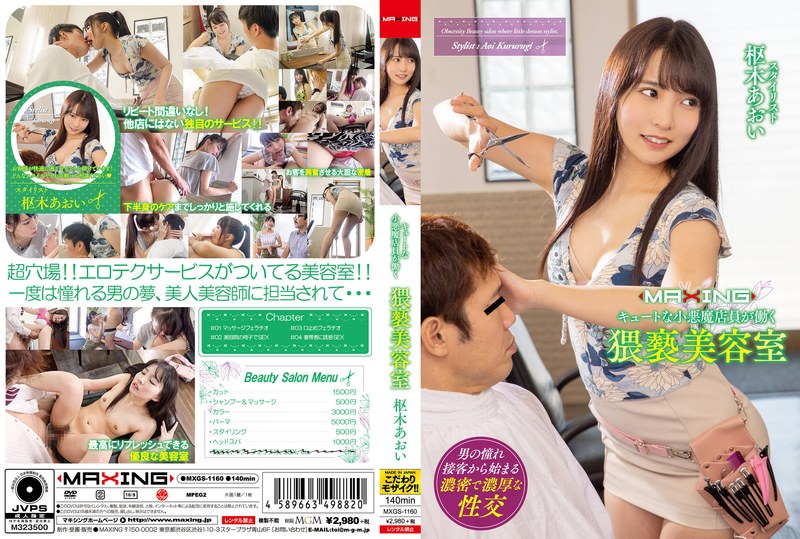
キュートな小悪魔店員が働く猥褻美容室 枢木あおい
View on FANZAI think a salon is fundamentally a space of permission. You let a stranger touch your head. You close your eyes, rest your neck in their hands. That intimacy, and then Aoi Kururugi’s little devil side on top of it. The reviews they left were all perfect marks—because the craft of the salon and her character line up exactly. The “work eyes” I wrote about in the story burn at a completely different temperature here, in an apron, closing the distance to a client. The “work eyes” I wrote about in the story—they wear a completely different temperature in that video.
Note: Product information is displayed in Japanese.
Related Articles
Aoi Kururugi Feature | VR Queen Who Sang, Acted, Graduated Over 7 Years
Aoi Kururugi's profile, career, and recommended works. From Kyoto underground idol to VR queen — 1,364 titles, music output, and an unconventional farewell.
Fantasy Girlfriend Diary | If Mei Miyajima Worked at an Apparel Shop
Imagine if Mei Miyajima were your apparel shop girlfriend. A fantasy story about her days off—drinking freely and laughing freely, showing her unguarded self.
Fantasy Girlfriend Diary | When Sakura Mana Is a Web Designer
What if Sakura Mana were a web designer girlfriend? An imaginary scenario story about reconciliation the day after their first real fight.
Fantasy Girlfriend Diary | If Miina Tsuji Were My Live House Staff Girlfriend
What if Miina Tsuji were your girlfriend working at a live music venue? The night her oshi announced graduation, she still ran the whole show. A fantasy story about her first tears.
Fantasy Girlfriend Diary | If Kaho Hanamori Were Your Relaxation Therapist
What if Kaho Hanamori were your relaxation therapist girlfriend? A fantasy-fueled scenario story—camera slung over her shoulder, the Sunday she first came to my hometown.
Fantasy Girlfriend Diary | If Saika Kawakita Were a Swim Coach
If Saika Kawakita were a swim coach girlfriend. Two weeks of fragmented days apart leading up to the prefectural tournament, where we couldn't see each other.
Fantasy Girlfriend Diary | Mia Nanasawa as Your Medical Clerk
What if Mia Nanasawa were your medical clerk girlfriend? A fantasy scenario about the night before her certification exam, entering her apartment for the first time.